
Xiangshan Wetland Oyster Learning Park: Marine Ecology, Oyster Farming and Community Conservation
Sustainable Development Goals
Content
Xiangshan Wetland Oyster Learning Park: Marine Ecology, Oyster Farming and Community Conservation
National Tsing Hua University — Zhusong Community College | Marine Environmental Education and Community Conservation Activities in 2025
Relevant Sustainable Development Goals: SDG 14 — Life Below Water; SDG 6 — Clean Water and Sanitation; SDG 4 — Quality Education; SDG 11 — Sustainable Cities and Communities; SDG 17 — Partnerships for the Goals
THE Impact Rankings Indicators: 14.3.1, 14.3.3, 14.5.2, 14.5.3 and 14.5.4
1. Oyster Learning Park: Marine Sustainability Education Rooted in Xiangshan Wetland
National Tsing Hua University (NTHU), through Zhusong Community College, promotes marine environmental education, aquatic ecological observation, and sustainable resource use through its Oyster Learning Park programme.
The initiative integrates the natural environment of Xiangshan Wetland with local oyster farming, community culture, and residents' everyday experiences.
Located along the Hsinchu coast, Xiangshan Wetland provides an important learning environment where intertidal ecosystems, oyster farming, and local livelihoods are closely connected.
Zhusong Community College uses the wetland and oyster farming areas as outdoor classrooms.
Through community field walks, investigations, water quality testing, industry interviews, and environmental documentation, participants explore the relationships among river watersheds, wastewater discharge, intertidal ecosystems, and marine environments.
The programme values the environmental knowledge accumulated by local residents and oyster farmers.
By connecting these experiences with teachers' expertise, learners' field investigations, and educational activities, marine ecosystem conservation becomes a subject that local communities can actively investigate and discuss.
In 2025, the programme included surveys of crab habitats, watershed exploration, wetland field walks, water quality testing, documentation of oyster farming, and the Oysters in Crisis marine education programme conducted with Xiangshan Elementary School.
Its documented outcomes primarily involve field observation, local knowledge collection, educational outreach, and community participation.
These activities provide a foundation for continued public engagement in wetland conservation.
2. Ecological Observation in Xiangshan Wetland: Understanding Intertidal Habitats
2.1 Field Survey of Crab Habitats — April 8, 2025
On April 8, 2025, Zhusong Community College organized a field survey of crab habitats in Xiangshan Wetland.
Participants visited wetland areas to observe crabs and their surrounding environments.
Through field observation and documentation, learners explored the characteristics of intertidal habitats and considered how environmental changes may affect the conditions required by aquatic and coastal organisms.
The activity combined ecological learning with practical field investigation.
Participants developed skills in environmental observation, documentation, and identification of potential habitat-related concerns.
Information gathered through such activities can also support future educational materials and community discussions concerning wetland conservation.
The documented achievement concerns ecological observation and field records.
It should not be interpreted as evidence that crab populations have increased or that wetland habitat conditions have already improved.
Supporting Evidence
Zhusong Community College, Field Survey of Crab Habitats in Xiangshan Wetland, April 8, 2025.
Recommended documentation: Field photographs, crab and habitat observation records, activity schedules, and participant field notes.
Relevant Indicators: 14.3.1, 14.3.3 and 14.5.2.
3. From Rivers to the Ocean: Watershed and Wetland Environmental Education
3.1 Oyster Discovery Tour: Watershed Edition — April 16, 2025
On April 16, 2025, Zhusong Community College organized Oyster Discovery Tour: Watershed Edition, connecting Keya Creek, a wastewater treatment facility, and interviews with oyster farmers.
The activity explored relationships among rivers, local industries, and coastal environments.
By examining environmental processes from inland waterways to coastal areas, participants learned how human settlements, industrial activities, and water-resource use are interconnected.
The programme also encouraged reflection on wastewater treatment, marine environmental protection, and the sustainable use of natural resources.
3.2 Xiangshan Wetland: Past and Present — May 15, 2025
On May 15, 2025, the In Search of Oysters programme offered the activity Xiangshan Wetland: Past and Present.
It introduced local history, environmental change, and experiences of wetland use as part of community environmental education.
Participants were encouraged to understand the ecological and social functions of wetlands through the relationships among local communities, industries, and natural environments.
3.3 An Educational Tour of Xiangshan Wetland — May 22, 2025
On May 22, 2025, Zhusong Community College organized An Educational Tour of Xiangshan Wetland.
Through guided field learning and environmental observation, participants explored the wetland landscape and intertidal environment.
The activity connected knowledge of local natural environments with water conservation, coastal ecology, and sustainable living.
It also increased opportunities for members of the public to learn about the importance of wetland protection.
Supporting Evidence
Zhusong Community College, 2025 Oyster Discovery Tour and In Search of Oysters programmes:
- April 16: Oyster Discovery Tour — Watershed Edition.
- May 15: Xiangshan Wetland — Past and Present.
- May 22: An Educational Tour of Xiangshan Wetland.
Recommended documentation: Activity posters, field-learning schedules, wetland photographs, interpretation materials, and interviews with local residents.
Relevant Indicators: 14.3.1 and 14.5.3.
4. From the Discharge Outlet to the Ocean: Water Quality Testing and Pollution Awareness
4.1 Water Quality Testing Activity — June 5, 2025
On June 5, 2025, Zhusong Community College organized From the Discharge Outlet to the Ocean — Exploring Water Quality through Testing.
The activity combined practical water quality testing with marine environmental education.
Focusing on the relationship between wastewater discharge and coastal environments, participants explored how water pollution may affect aquatic ecosystems.
Through hands-on testing and discussion, learners developed awareness of water quality changes and the importance of protecting rivers and coastal waters.
The programme also encouraged participants to develop skills in environmental observation and documentation.
These experiences support public understanding of water pollution prevention and citizen participation in aquatic environmental monitoring.
4.2 Developing Community Water Monitoring Capacity
Through Oyster Learning Park and its broader watershed education activities, Zhusong Community College continues to provide opportunities for hands-on water quality testing and environmental observation.
These activities encourage learners to examine relationships among everyday life, industrial activity, pollutants, and aquatic environmental quality.
Practical testing sessions offer opportunities for environmental learning and local data collection.
Further development of consistent sampling locations, defined parameters, and comparable records across multiple periods could strengthen long-term monitoring of aquatic ecosystem health.
The available 2025 information documents water quality testing activities but does not yet establish comprehensive long-term trends in water quality or aquatic ecosystem health.
Supporting Evidence
Zhusong Community College, From the Discharge Outlet to the Ocean — Exploring Water Quality through Testing, June 5, 2025.
Recommended documentation: Water testing photographs, sampling locations, measured parameters, and original measurement records.
Relevant Indicators: 14.3.1, 14.5.2 and 14.5.3.
5. Documenting the Oyster Farming Industry: Connecting Local Livelihoods with Sustainable Marine Resource Use
5.1 A Year of Documenting the Oyster Farming Industry — April to September 2025
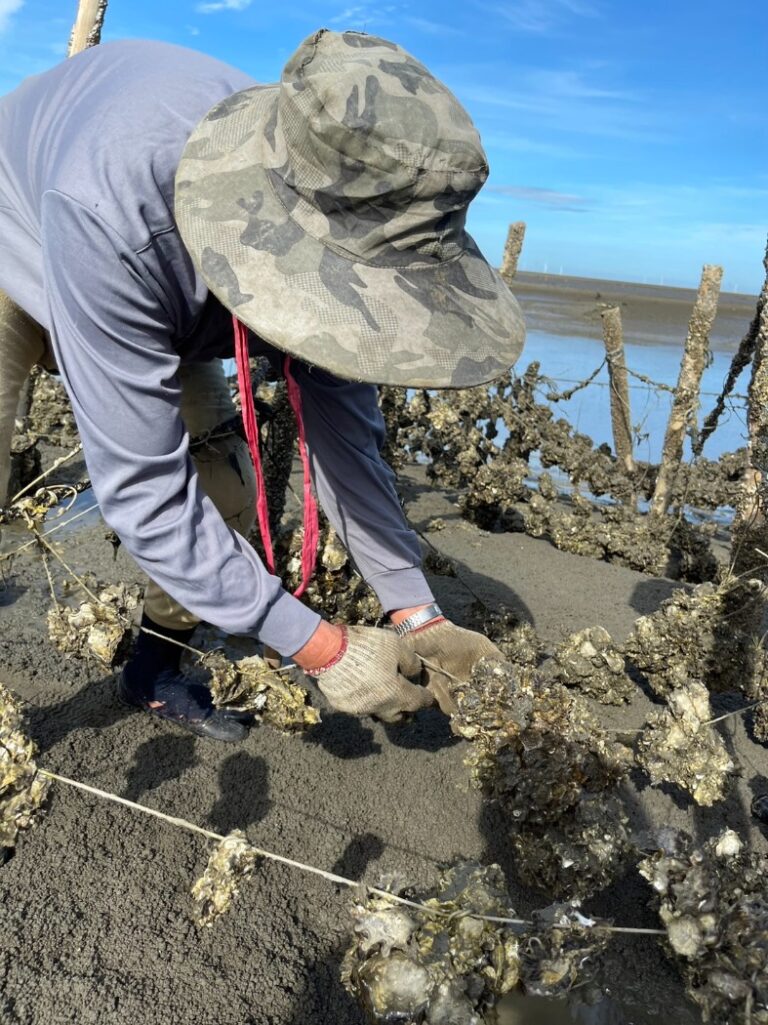
From April to September 2025, Zhusong Community College worked with local oyster farmers in Xiangshan to document aquaculture practices and associated environmental conditions.
The programme involved community partners including the Meishan community and the Lin family's oyster farming business.
Through observation in oyster farming areas, documentation of aquaculture operations, interviews, and environmental data collection, participants explored relationships between the oyster industry and coastal ecological conditions.
Major field documentation activities were conducted on April 21, June 30, August 25, and September 8, with the broader recording period extending from April 21 to September 30.
5.2 Understanding Aquatic Environments through Oyster Farming
Oyster farming is closely connected to intertidal environmental conditions.
Water quality, climate, environmental changes, and industrial activities can influence farming conditions and local livelihoods.
Through interviews and documentation, participants learned how oyster farmers observe environmental changes and how local livelihoods depend on aquatic resources.
These activities preserve local industry knowledge while contributing information that may support future discussions of aquaculture environmental protection and sustainable marine resource use.
5.3 Documenting Local Knowledge for Future Conservation
Zhusong Community College organized findings into photographs, interviews, and educational materials.
These resources enable community knowledge about oyster farming to be shared beyond individual households and businesses.
The documented work currently emphasizes industry records, environmental observations, and local knowledge.
It does not establish that particular aquaculture technologies have already been improved, pollution loads reduced, or industry-wide sustainability transitions completed.
Supporting Evidence
Zhusong Community College, A Year of Documenting the Oyster Farming Industry, April 21–September 30, 2025.
Major field dates: April 21, June 30, August 25, and September 8.
Recommended documentation: Cooperation records with the Lin family's oyster farming business, field photographs, farmer interviews, and documentation outputs.
Relevant Indicators: 14.3.3, 14.5.2 and 14.5.4.
6. Oysters in Crisis: Extending Marine Education to Elementary School Students
In 2025, Zhusong Community College collaborated with Xiangshan Elementary School to implement Oysters in Crisis, an educational programme connecting wetland ecology, oyster farming, and marine environmental protection with primary education.
Activities were conducted on:
- September 18, 2025.
- October 2, 2025.
- October 16, 2025.
Through wetland ecological observation and marine environmental education, participating schoolchildren learned about oyster farming, intertidal organisms, and local natural environments.
The programme encouraged children to begin with familiar local places and understand the relationships between coastal environments and community life.
It also introduced the importance of aquatic ecosystem conservation.
By translating local knowledge and field observations into learning experiences for children, the collaboration connected community college education with primary school teaching.
Such partnerships provide opportunities for intergenerational environmental learning and continued engagement between local schools and communities.
Supporting Evidence
Zhusong Community College and Xiangshan Elementary School, Oysters in Crisis, September 18, October 2, and October 16, 2025.
Recommended documentation: Course photographs, lesson plans, student learning records, and school collaboration records.
Relevant Indicators: 14.3.1, 14.5.3 and 14.5.4.
7. Working with Local Communities to Protect Shared Aquatic Environments
7.1 Meishan Community: Oyster Farming and Environmental Documentation
Zhusong Community College cooperated with the Meishan community and the Lin family's oyster farming business to document aquaculture practices, environmental conditions, and the experiences of local oyster farmers.
These activities connected local industry knowledge with learners' field investigations and encouraged shared attention to coastal environmental conditions and sustainable resource use.
7.2 Chaoshan Community: Field Investigation and Civic Participation
In 2025, Zhusong Community College organized In Search of Oysters — An Introduction to Field Investigation in the Chaoshan community.
The programme developed participants' skills in environmental observation, field documentation, and interviews.
Activities were conducted on May 15, May 22, June 5, June 12, and during July 7–28.
Through community-based investigation, learners examined environmental change and aquatic conservation concerns from the perspectives of local livelihoods and industries.
7.3 Nanai Community: Water Quality Testing and Stream Protection
Zhusong Community College also collaborated with the Nanai community and Nanai Elementary School on Tracing the Stream to Its Source — Water Resource Conservation in Yanshuigang, conducted from February 27 to June 26, 2025.
Through field visits, water quality testing, and environmental observations, participating students and residents examined relationships among water quality, agricultural irrigation, and aquatic ecosystems.
Activities included measurements of pH, dissolved oxygen, and turbidity.
The programme also incorporated a stream cleanup activity undertaken with the local school.
According to the community college's self-evaluation report, the programme recorded 64 participant attendances.
7.4 A Collaborative Community Conservation Model
By engaging the Meishan, Chaoshan, and Nanai communities, Zhusong Community College has developed connections among local residents, oyster farmers, teachers, learners, and schools.
Within this approach, community members contribute experience and local knowledge, while educators and participants help document environmental conditions and organize learning materials.
Schools also help bring these topics to younger generations.
These partnerships provide a foundation for continued discussion of water quality, aquatic ecology, and resource use.
They demonstrate how a university-affiliated community college can cooperate with local communities in efforts to protect shared aquatic environments.
Supporting Evidence
Zhusong Community College, 2025 programme records:
- Meishan community and the Lin family's oyster farming business: Documentation of the Oyster Farming Industry.
- Chaoshan community: In Search of Oysters — An Introduction to Field Investigation.
- Nanai community and Nanai Elementary School: Tracing the Stream to Its Source — Water Resource Conservation in Yanshuigang.
- Nanai Elementary School partnership: Yanshuigang Creek cleanup activity.
Recommended documentation: Community cooperation records, field photographs, interview materials, water quality data, and cleanup records.
Relevant Indicators: 14.5.3 and 14.5.4.
8. Sharing Local Knowledge and Marine Environmental Education Resources
Zhusong Community College places importance on transforming wetland investigations, industry documentation, and community interviews into educational resources that can support continued learning.
Outputs include field photographs, local stories, oyster farming records, ecological observations, and teaching materials.
Through the educational resource collection Xiangshan Paths: Oyster Learning Park (《香間小路:蚵學園區》), the community college has further organized local knowledge into teaching resources.
These materials support continued learning about Xiangshan Wetland, oyster farming, and local environmental conditions.
This approach allows programme outcomes to extend beyond individual participants and become resources for future courses, guided field activities, and public education.
By organizing and sharing local knowledge, the programme supports continued community attention to aquatic biodiversity, wetland environments, and cultural heritage.
Supporting Evidence
Xiangshan Paths: Oyster Learning Park teaching resource collection and associated educational materials.
Recommended documentation: The publication cover, table of contents, selected teaching materials, and publication or compilation year.
Relevant Indicators: 14.3.1 and 14.5.3.
9. Achievements in 2025 and Contributions to Aquatic Conservation
In 2025, Zhusong Community College used Xiangshan Wetland and surrounding watersheds as learning environments, working with local schools, communities, and the oyster farming industry to deliver marine and freshwater environmental education.
Key achievements included:
- Wetland ecological observation: Conducting a field survey of crab habitats and documenting intertidal organisms and environmental conditions.
- River-to-ocean education: Helping participants understand relationships among rivers, wastewater discharge, and coastal environments through watershed exploration and wetland field walks.
- Hands-on water quality testing: Providing opportunities to observe water conditions and learn about pollution prevention.
- Oyster farming documentation: Working with local farmers to record aquaculture practices, environmental conditions, and community experiences.
- Marine education for schoolchildren: Collaborating with Xiangshan Elementary School on Oysters in Crisis to introduce wetland conservation to younger learners.
- Community participation: Engaging the Meishan, Chaoshan, and Nanai communities through investigations, water testing, and educational activities.
- Educational resource development: Converting local investigations and industry knowledge into teaching materials that can be reused.
These achievements demonstrate NTHU's support for aquatic environmental conservation and the sustainable use of resources through continuing education and community partnerships.
The documented outcomes primarily involve environmental education, field observation, local data collection, and community participation.
The currently available records do not provide sufficient evidence to quantify reductions in marine pollution, increases in protected habitat area, or recovery of aquatic species populations.
10. Continuing Commitment to Marine Ecology and Local Sustainability
National Tsing Hua University will continue supporting collaboration among Zhusong Community College, local schools, community residents, and oyster farming partners to promote marine ecology education, coastal environmental protection, and sustainable community learning.
Building upon existing wetland investigations and water quality testing activities, the university seeks to encourage further collection of comparable environmental records and strengthen ecological observation, local knowledge documentation, and educational assessment.
Through university–community collaboration, NTHU aims to increase opportunities for people of different generations to understand and participate in aquatic environmental protection.
These efforts support the sustainable coexistence of Xiangshan Wetland, coastal industries, and local communities.
The initiative directly contributes to SDG 14: Life Below Water and connects with SDG 6, SDG 4, SDG 11, and SDG 17 through water-resource protection, environmental education, and partnerships.