
Aquatic Ecosystem Protection and Pollution Risk Management Plan
Sustainable Development Goals
Content
NTHU Aquatic Ecosystem Protection and Pollution Risk Management Plan: Addressing Physical, Chemical and Biological Risks in the Touqian River Watershed
National Tsing Hua University | 2025 Watershed Conservation and Environmental Risk Management
THE Impact Rankings 14.5.1 — Minimizing Alteration of Aquatic Ecosystems (Plan)
Relevant SDGs: SDG 14 Life Below Water, SDG 6 Clean Water and Sanitation, SDG 11 Sustainable Cities and Communities, and SDG 17 Partnerships for the Goals
1. Background and Objectives
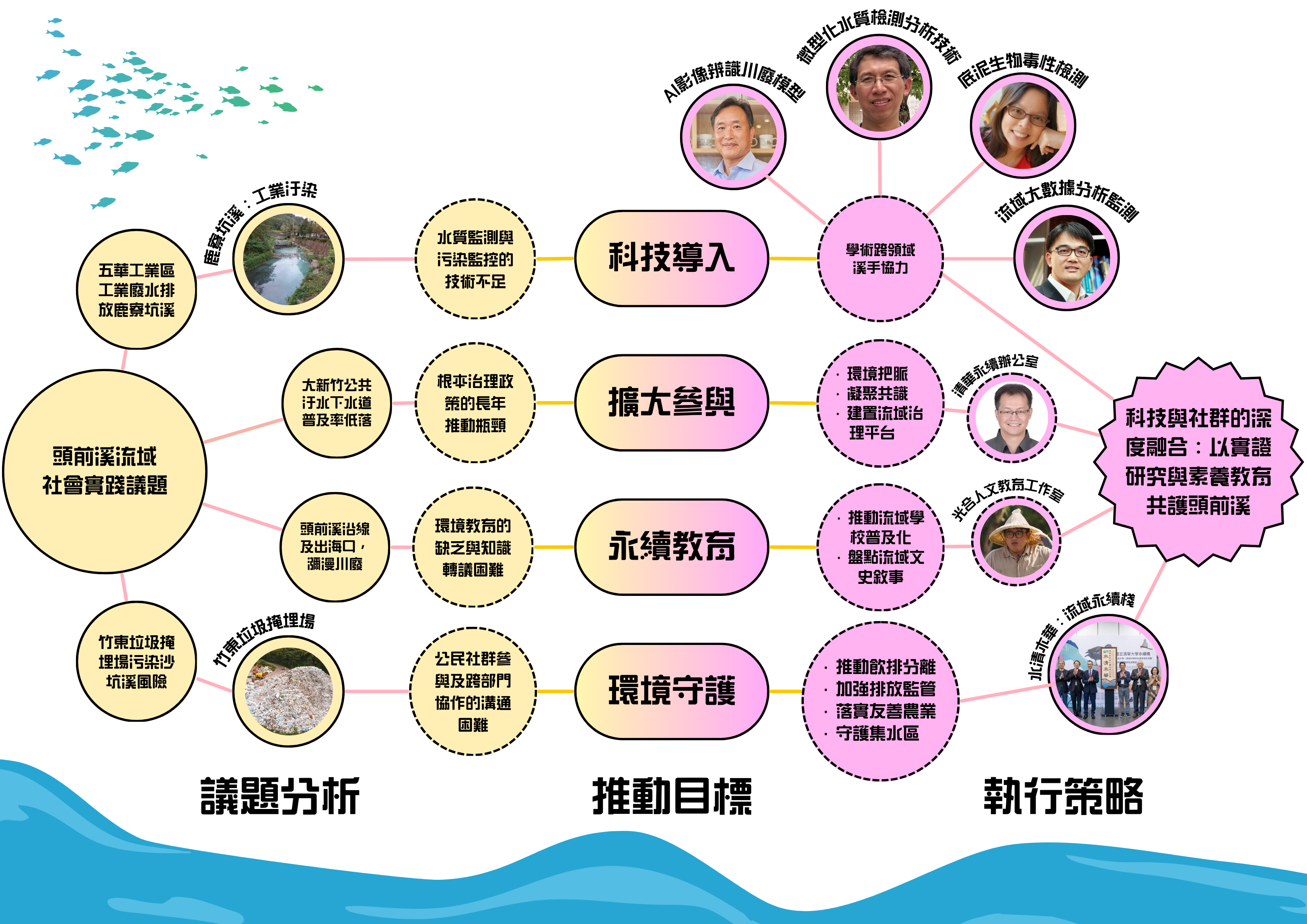
National Tsing Hua University (NTHU) implements the Ministry of Education-supported University Social Responsibility (USR) project, Deep Integration of Technology and Communities: Protecting the Touqian River Through Evidence-Based Research and Environmental Literacy.
The Touqian River watershed faces environmental challenges associated with water pollution, contaminated sediments, river litter, water security, and human activities affecting estuarine habitats.
Physical disturbance, chemical contamination, and changes to biological habitats may affect freshwater and downstream aquatic ecosystems.
NTHU adopts a watershed-based approach that integrates environmental science, information technology, public participation, and cross-sector collaboration.
The project's principal objectives are to:
- Identify water quality, sediment, and riverbank environmental risks through scientific monitoring.
- Develop rapid water analysis and AI-based river litter detection technologies.
- Support pollution prevention and aquatic conservation through community engagement and environmental education.
- Integrate scientific research and government monitoring data to inform watershed management recommendations.
- Review progress through interdisciplinary coordination, annual performance evaluation, and policy dialogue.
These activities support efforts to understand and potentially reduce human impacts on aquatic ecosystems. However, the currently documented results primarily demonstrate monitoring, risk assessment, and cooperation rather than verified reductions in all forms of ecological alteration.
2. Implementation Structure and Management Mechanisms
In 2025, the Touqian River USR project was led by Professor Hsiu-Chuan Chou of NTHU's Institute of Analytical and Environmental Sciences, together with interdisciplinary teams specializing in water analysis, sediment contamination and toxicity, AI image recognition, environmental education, and policy engagement.
According to the 2025 project implementation report, the management framework includes:
- Regular coordination: Monthly project meetings to review progress and coordinate activities.
- Defined research responsibilities: Specialist teams working on water quality, sediment toxicity, AI monitoring, education, and policy engagement.
- Adaptive review: Adjustments to project activities based on implementation progress and field requirements.
- Performance assessment: Quantitative indicators, qualitative feedback, and annual reporting under Ministry of Education USR requirements.
- External collaboration: Engagement with government agencies, environmental organizations, schools, and local communities.
This structure supports ongoing watershed research and environmental risk assessment. It does not imply that NTHU has statutory authority to manage the entire Touqian River watershed.
3. Physical Alterations: River Litter, Environmental Observation and Cleanup Activities
3.1 AI-Based River Litter Detection
Riverbank litter and solid waste may affect aquatic habitats and be transported downstream toward estuarine and coastal ecosystems.
In 2025, NTHU developed an AI-based river litter recognition system to collect and classify environmental image data.
Documented outputs included:
- 77,886 collected river environment images.
- 5,769 annotated images.
- 15 litter categories.
- mAP50 of 0.945.
The technology supports the identification of litter types and provides information that may assist environmental inspections, litter hotspot investigations, and future cleanup planning.
These figures measure data collection and model performance. They do not represent quantities of waste removed or areas of habitat restored.
3.2 Community Observation and Cleanup
NTHU cooperates with local river protection groups, volunteers, and community residents through environmental observation, field activities, and conservation education.
Previous activities included a 2024 coastal cleanup near Jiugang Island, where participants documented collected waste using a structured classification approach.
In 2025, the project continued to support local participation in river observation, pollution awareness, and environmental exchange.
These activities encourage community engagement in protecting aquatic environments. However, the current documentation does not establish a watershed-wide cleanup management programme with binding schedules and quantified litter reduction targets.
4. Chemical Alterations: Water Quality, Sediment Toxicity and Pollution Prevention
4.1 Water Quality Monitoring
In 2025, the Touqian River project established eight water sampling sites, conducted 15 sampling occasions, and expanded the number of analytical parameters from eight to 12, including indicators associated with heavy metals and suspended solids.
The team also integrated rapid water quality analysis techniques to support the identification of pollution risks at different watershed locations.
Field sampling and laboratory analysis provide evidence for understanding contamination patterns and identifying issues requiring further investigation.
4.2 Sediment Contamination and Toxicity
River sediments may accumulate contaminants that are not fully represented by measurements of the overlying water.
NTHU researchers investigate sediment contamination through chemical analysis of heavy metals and organic pollutants, complemented by cell-based toxicity assessment.
Combining chemical and biological response information supports broader environmental risk screening.
Nevertheless, results from cell-based assays cannot automatically be interpreted as evidence of a specific degree of injury to wildlife populations in the river.
4.3 Data Integration and Policy Recommendations
The university also analyzes government water quality datasets, automated monitoring records, and rainfall data to better understand long-term trends and short-term environmental changes.
During 2025, researchers participated in interagency policy discussions and expert consultations addressing high-frequency monitoring, emerging contaminants, pollution warning systems, and pollution source identification.
These efforts provide technical input for public authorities. They are not presented as proof that all recommended pollution control measures have been formally adopted or implemented.
5. Biological Alterations: Ecological Risk Assessment and Habitat Awareness
5.1 Biological Risk Assessment
The project incorporates sediment cell-toxicity assessment into its pollution research, providing supplementary information beyond conventional measurements of chemical concentrations.
This helps identify potential biological hazards associated with contaminated sediments.
However, cell-based toxicity research does not replace field surveys of fish, benthic organisms, or other aquatic species.
5.2 Estuarine Ecology Education
In September 2025, NTHU students and faculty participated in an educational field visit to the Touqian River estuary in cooperation with local river conservation partners.
Participants observed river channels, sediment deposits, intertidal habitats, and relationships between human activities and estuarine ecosystems.
Field observations included fiddler crabs and other aspects of estuarine ecology.
The activity contributed to ecological awareness and environmental education. It is not presented as evidence of completed habitat restoration, species recovery, or enforceable biodiversity management measures.
5.3 Further Conservation Requirements
A comprehensive aquatic ecosystem impact minimization plan would also require habitat-specific assessments, aquatic species surveys, evaluation of biological disturbance, and documented mitigation actions.
These are areas requiring further development or verification, rather than confirmed outputs completed in 2025.
6. Community Partnerships and Cross-Sector Governance
The Touqian River watershed extends across administrative boundaries and involves government agencies, water management authorities, environmental groups, and local communities.
In 2025, the NTHU USR project recorded 327 participant attendances among local residents, volunteers, and community groups, together with cooperation involving five government or non-governmental organizations.
The project also organized four interagency policy consultation meetings addressing pollution monitoring, sediment toxicity, emerging contaminants, and watershed governance.
NTHU contributed scientific analysis, monitoring information, educational activities, and student participation, while local partners provided field observations, environmental experience, and community perspectives.
These partnerships support shared environmental understanding and pollution prevention. Formal regulatory decisions and remediation responsibilities remain with the relevant competent authorities.
7. Documented Outcomes and Plan Review in 2025
Management areaDocumented 2025 outputsInterpretationPhysical environmental risks77,886 images, 15 litter classes, mAP50 of 0.945River litter identification technology developedChemical environmental risks8 sampling sites, 15 sampling occasions, 12 analytical parametersWatershed water quality monitoring conductedBiological environmental risksSediment toxicity research and estuarine observationsBiological risk research and ecological education undertakenCommunity participation327 community participant attendancesCommunity participation documentedExternal collaboration5 partner organizations and 4 policy consultation meetingsCross-sector dialogue and cooperation documentedProject managementMonthly meetings, adaptive review, annual assessmentOngoing USR project management procedures established
The project demonstrates a sustained framework for environmental monitoring, pollution risk identification, education, and stakeholder engagement.
However, the available evidence does not establish quantified watershed-wide pollution reductions, habitat restoration areas, aquatic species recovery, or shared mitigation targets covering all physical, chemical, and biological alterations.
Monitoring performance and participation figures are therefore not presented as direct measures of ecosystem restoration.
8. Future Development
Building on its existing research and collaborative mechanisms, NTHU may further strengthen aquatic ecosystem protection by:
- Developing an integrated assessment framework for physical, chemical, and biological environmental impacts.
- Identifying priority pollution hotspots and environmentally sensitive habitats based on monitoring evidence.
- Working with relevant authorities on practical pollution prevention, river litter removal, and habitat protection actions.
- Expanding surveys of aquatic species and ecologically important habitats.
- Defining measurable mitigation targets, implementation responsibilities, and periodic review procedures.
These measures represent potential directions for strengthening the existing watershed programme. They should not be interpreted as actions already approved or completed.
NTHU will continue to integrate scientific research, environmental education, and local cooperation to support pollution prevention, aquatic environmental risk assessment, and sustainable development in the Touqian River watershed.
Supporting Evidence
- Ministry of Education USR Project — 2025 Implementation Report: Deep Integration of Technology and Communities.
- NTHU Touqian River USR Project Overview.
- NTHU SDGs website: Touqian River Sustainable Watershed Community: Water Conservation, Scientific Monitoring and Local Partnerships.
Evidence qualification: This webpage consolidates the existing USR implementation framework and its documented 2025 activities from an aquatic ecosystem risk management perspective. It does not constitute evidence that NTHU has separately approved a comprehensive watershed mitigation plan covering all physical, chemical, and biological alterations.