
Education for SDGs: Specific Courses on Sustainability
Sustainable Development Goals
Content
NTHU Dedicated Sustainability Courses and Interdisciplinary Education
THE Impact Rankings 17.4.2 — Education for SDGs: Specific Courses on Sustainability
1. Institutional Commitment to Dedicated Sustainability Education
National Tsing Hua University (NTHU) offers degree programmes, specialist electives, general education courses, and practice-oriented learning opportunities addressing the United Nations Sustainable Development Goals (SDGs).
Its sustainability-related education covers environmental management, climate change, ESG and corporate responsibility, pollution prevention, sustainable engineering, health equity, cultural heritage, and responsible governance.
The university provides learning pathways at undergraduate, master's, and professional education levels.
Teaching approaches include lectures, case studies, quantitative analysis, geographic information systems, field investigations, research projects, and practical training.
Through these programmes and courses, students develop disciplinary knowledge and professional skills relevant to environmental, social, and economic sustainability.
2. Dedicated Degree Programmes in Environmental and Cultural Resources
2.1 Bachelor's, Master's, and Executive Master's Programmes
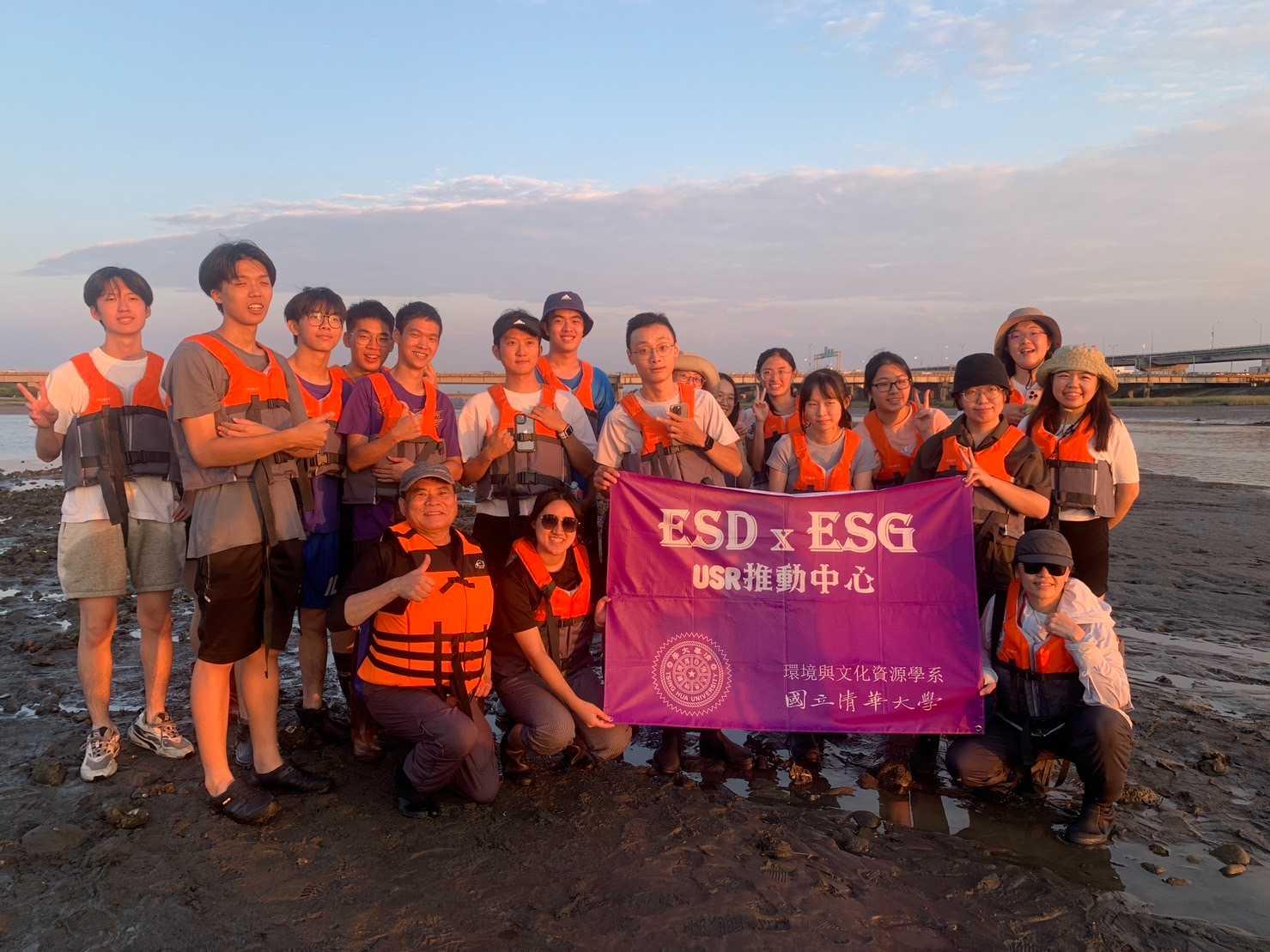
NTHU's College of Education houses the Department of Environmental and Cultural Resources, which provides interdisciplinary education in environmental management, cultural sustainability, regional development, and governance.
According to the college's submission, the department offers three degree pathways:
ProgrammeRequired CreditsMajor FocusBachelor's128Ecology, society, culture, resources, and governanceMaster's33Environmental management and regional cultural developmentExecutive Master's33Environmental and cultural resource analysis, community learning, and sustainability governance
Together, these programmes provide structured educational opportunities for students and working professionals interested in sustainability-related fields.
2.2 Undergraduate Education in Environmental and Social Sustainability
The bachelor's programme emphasizes four interconnected dimensions: environmental ecology, socio-cultural development, economic resources, and policy governance.
Students develop interdisciplinary perspectives through core courses, electives, geographic information systems (GIS), and fieldwork.
The programme aims to prepare graduates with knowledge relevant to sustainable resource management, local development, and environmental governance.
2.3 Graduate Research in Environmental Management
The master's programme focuses on environmental management and regional cultural development.
It integrates sustainability-related research topics, including climate change adaptation, environmental resources, cultural heritage, and local development.
Students strengthen their analytical and research capabilities while exploring relationships among environmental and social systems.
2.4 Executive Education for Sustainability Professionals
The executive master's programme provides opportunities for working professionals to develop expertise in environmental and cultural resource management, community development, and sustainability governance.
It connects academic analysis with professional experience and local management needs.
Potential professional pathways include resource management, cultural industries, community development, and ESG-related functions.
2.5 Research Methods, GIS, and Evidence-based Analysis
The department incorporates quantitative data analysis, GIS, field investigation, and research methods into its educational approach.
These tools enable students to investigate environmental conditions, analyze regional challenges, and develop research-informed recommendations.
Supporting Evidence
Source: NTHU College of Education, Department of Environmental and Cultural Resources, 2025 institutional submission.
Recommended documentation: Official degree programme descriptions, academic regulations, credit requirements, curriculum structures, and representative course syllabi.
Direct links to the programme-specific documents remain to be added.
Relevant SDGs: 4, 11, 12, 13, 15, and 17.
3. ESG and Social Innovation
3.1 ESG and Social Innovation (IPMT300900)
NTHU's College of Technology Management offers the dedicated course ESG and Social Innovation (Course Code: IPMT300900) through its IBBA programme.
The course integrates sustainability principles and the SDGs into business and management education.
Topics include environmental, social and governance (ESG) practices, corporate social responsibility (CSR), social innovation, social enterprises, net-zero carbon emissions, climate change, and sustainable finance.
Teaching approaches include lectures, case studies, guest presentations, and project-based learning.
Students examine how businesses and social enterprises can respond to environmental and social challenges and incorporate sustainability into organizational decisions and business strategies.
The course directly addresses sustainability as a central educational subject.
Supporting Evidence
Source: NTHU College of Technology Management.
The departmental submission identifies the official ESG and Social Innovation (IPMT300900) course syllabus for Fall 2025.
The syllabus should be attached to the webpage to document learning objectives, teaching topics, assessment methods, and the academic term.
Relevant SDGs: 4, 8, 9, 12, 13, and 17.
4. Sustainable Engineering and Management
4.1 Sustainable Engineering and Management (IEEM554600)
Professor Ming-Chuan Chiu of NTHU's Department of Industrial Engineering and Engineering Management teaches Sustainable Engineering and Management (Course Code: IEEM554600).
The course introduces sustainability issues and emerging trends across design, production, services, supply chains, and corporate governance.
Through practical case studies and best-practice discussions, students develop an understanding of how sustainability considerations influence engineering and management decisions.
The course supports the development of knowledge and skills relevant to sustainable industrial practices and organizational transformation.
As sustainability is the primary subject of the course, it provides a direct example of dedicated SDG-related instruction.
Supporting Evidence
Source: NTHU College of Engineering's institutional submission.
Recommended documentation: Official course syllabus, course offering records, and details of sustainability case studies and assignments.
Relevant SDGs: 8, 9, 12, and 13.
4.2 Microsystems and Sustainability-related Engineering Education
NTHU's Institute of NanoEngineering and MicroSystems provides graduate education in biomedical microsystems, sensors, semiconductor processing, nanomaterials, and advanced manufacturing.
For example, Semiconductor Process and Device Characterization for MEMS (NEMS5150) provides hands-on training in semiconductor fabrication and device measurement.
Related research and training involve potential applications in health technologies, resource efficiency, and sustainable chemical processing.
In 2026, the institute also contributed to the International Symposium on Microfluidic Chemical Processing & Technology, connecting engineering education with research and industrial applications.
However, NEMS5150 is primarily a technical engineering course rather than one exclusively focused on sustainability. Its inclusion is therefore supplementary to dedicated courses such as Sustainable Engineering and Management.
Supporting Evidence
Source: NTHU Institute of NanoEngineering and MicroSystems, 2025–2026 institutional submission.
Recommended documentation: NEMS5150 syllabus and research training materials identifying specific sustainability-related learning outcomes.
Relevant SDGs: 3, 9, and 12.
5. Water Pollution Prevention and Emerging Environmental Contaminants
5.1 Water Pollution Control
NTHU's College of Nuclear Science offers the elective Water Pollution Control.
The course examines pollution sources, environmental impacts, analytical methods, monitoring techniques, and technologies for pollution prevention and treatment.
Through lectures and practical examples, students develop knowledge of water-resource protection and environmental management.
The course provides specialized education directly related to water quality improvement and pollution reduction.
5.2 Emerging Contaminants in the Environment
The elective Emerging Contaminants in the Environment examines the occurrence, monitoring, and potential environmental impacts of emerging pollutants.
Students learn about analytical approaches, environmental risks, and challenges for aquatic ecosystems.
The course encourages the application of scientific knowledge to water pollution management and environmental protection.
Together, these courses provide direct examples of formal sustainability-related education addressing SDG 6.
Supporting Evidence
Source: NTHU College of Nuclear Science institutional submission.
Recommended documentation: Official course syllabi, course codes, academic terms, and related teaching materials.
Relevant SDGs: 6, 12, and 14.
6. Sustainability Law, Food Safety, and Institutional Governance
6.1 Food Safety, Sustainability, and Corporate Governance (Spring 2025)
In Spring 2025, Professor Ching-Fu Lin and Professor Chang-Hsien Tsai of NTHU's Institute of Law for Science and Technology co-taught Food Safety, Sustainability, and Corporate Governance.
The course examined food safety challenges from the perspectives of globalization, sustainable development, legal policy, and corporate governance.
Students considered the roles of law, public policy, businesses, and professional decision-makers in responding to food safety risks.
The course connected public health, corporate accountability, consumer protection, and sustainability governance.
Its teaching content was directly related to SDGs 3, 6, 8, 9, and 12.
Supporting Evidence
NTHU Food Safety, Sustainability, and Corporate Governance course materials:
https://drive.google.com/file/d/1grJd_Y-S3od4oTpcEwNGBCrXSYkGRa9G/view?usp=sharing
Relevant SDGs: 3, 6, 8, 9, and 12.
6.2 Crime and Punishment in Daily Life: Introduction to Criminal Law
Assistant Professor Tsung-Yuan Lee of NTHU's Institute of Law for Science and Technology offers the university-wide general education elective Crime and Punishment in Daily Life: Introduction to Criminal Law.
Using current news and practical legal cases, the course introduces criminal law, procedural justice, and fundamental rights.
Topics include anti-corruption, fraud, organized financial crime, the presumption of innocence, wrongful convictions, defendants' rights, freedom of expression, privacy, and gender-based violence.
The course also includes guest lectures by judges and prosecutors.
Students engage in case analysis, class discussion, and reflective writing to develop civic legal literacy and an understanding of institutional justice.
The course is directly relevant to SDG 16 and selected targets under SDG 5.
Supporting Evidence
NTHU Official Course Syllabus:
Relevant SDGs: 4, 5, 10, and 16.
7. Community and Rural Healthcare Practice
7.1 Practice-based Education in Underserved Communities
NTHU's School of Post-Baccalaureate Medicine collaborates with Taipei Veterans General Hospital Hsinchu Branch, Daan General Hospital in Miaoli, and Landseed International Hospital in Taoyuan to offer a one-week Community and Rural Healthcare Practice Course during the winter break.
The course develops students' understanding of primary healthcare, rural medical needs, and healthcare accessibility.
Under the guidance of clinical instructors, students participate in learning activities involving hospitals, community healthcare facilities, mobile medical services, health stations, local clinics, and home healthcare.
These experiences allow medical students to observe differences in healthcare provision across communities.
7.2 Experiential Learning and Professional Reflection
At the conclusion of the course, students gather at Daan General Hospital to present their experiences and receive feedback from clinical instructors and NTHU faculty members.
Through observation, field practice, and reflection, students connect medical knowledge with the challenges of delivering healthcare in underserved areas.
The course helps develop professional responsibility and understanding of health equity.
Supporting Evidence
Medical field visit with Taipei Veterans General Hospital Hsinchu Branch:
https://www.atanews.net/?news=111680
NTHU medical students' rural healthcare learning at Daan General Hospital:
https://www.epochtimes.com/b5/25/1/18/n14416469.htm
Recommended documentation: Official course timetable, curriculum requirements, student assessment records, and final presentations.
Relevant SDGs: 3, 4, and 10.
8. Teacher Education and Sustainability-related Educational Issues
8.1 Educational Issues Seminar
NTHU's Center for Teacher Education includes Educational Issues Seminar as a compulsory course within its professional teacher education curricula for secondary and elementary school teacher candidates.
The course introduces major educational issues and their applications in classroom teaching.
Topics include gender equality, human rights, environmental education, multicultural education, technology, and special education.
These areas are relevant to inclusive, equitable, and sustainability-oriented education.
The compulsory requirement applies to the relevant teacher education programmes rather than to every student at NTHU.
8.2 Teaching Practice Connection Support Programme
Through the Teaching Practice Connection Support Programme, NTHU supports instructors in developing teaching units related to sustainability and major social issues.
The programme connects university-based teacher preparation with classroom practice in primary and secondary education.
Student teachers learn to translate environmental and social issues into curriculum design, teaching activities, and educational reflection.
Supporting Evidence
Source: NTHU Center for Teacher Education, 2025 institutional submission.
Recommended documentation: Official teacher education curriculum requirements, Educational Issues Seminar syllabus, and teaching practice outcomes.
Relevant SDGs: 4, 5, 10, 16, and 17.
9. Health and Well-being Micro-credit Courses
9.1 Body Composition Control: The Practice of Exercise and Diet
In the second semester of Academic Year 114 (Spring 2026), NTHU's Health Services Division introduced the micro-credit course Body Composition Control: The Practice of Exercise and Diet.
The course focuses on sustainable health habits through exercise planning, nutrition, and behavioral change.
Students explore practical approaches to maintaining healthy lifestyles over time.
9.2 Smoke-Free, Healthy New Life
The micro-credit course Smoke-Free, Healthy New Life addresses tobacco prevention, health promotion, and the effects of smoking on human health and the environment.
Learning activities include fitness, stress-relief art, nutrition guidance, and practical health education.
These courses contribute to health and well-being education and represent NTHU's continuing development of SDG-related learning opportunities in 2026.
Supporting Evidence
NTHU Health Services Division Micro-credit Courses:
https://health.site.nthu.edu.tw/p/406-1001-260897,r7605.php?Lang=zh-tw
Relevant SDGs: 3 and 4.
10. Sustainability-focused General Education Electives
NTHU's Center for General Education offers a range of electives addressing environmental sustainability, energy, biodiversity, responsible consumption, and resource management.
According to the 2025 institutional submission, the courses include:
- Sustainable Development.
- Design Thinking for Sustainable Environmental Governance.
- Changes and Sustainability of Nature.
- Ecosystem and Global Changes.
- Impact of Global Energy Shortage.
- Global Warming and Environmental Impact.
- Introduction to Energy and Environment.
- Environmental Protection and Life.
- Food Literacy and Sustainable Food Design.
- Exploration and Practice of Aquatic and Wetland Plants in Taiwan.
- Knowing Fungi.
- Changes and Sustainability of Nature: Selected Lectures (MOOC).
- Food Safety and Life.
- Exploration and Practice for Wildlife Conservation.
- Genetically Modified Foods and Health.
- Naturalistic Intelligence.
- Science of Animal Life.
- Environmental Planning and Management.
- Dark Sky and Sustainability.
- Rebirth of Waste: Circular Materials and the Green Revolution in Energy Storage.
These courses provide opportunities for students from different disciplines to study sustainability-related topics through natural science, environmental management, food systems, and technology.
For this indicator, courses with sustainability as a central learning objective should be prioritized. The relevance of other courses can be verified through their official syllabi.
Supporting Evidence
NTHU General Education Course Catalogue:
https://www.ccxp.nthu.edu.tw/ccxp/INQUIRE/JH/6/6.2/6.2.F/JH62f002.php
Recommended documentation: Academic-year course offerings and representative syllabi.
11. Institutional Scope of Sustainability-related Courses
According to NTHU's Secretariat, the university offered 5,906 courses in 2025, including 3,787 classified as sustainability-related, accounting for approximately 64% of the total.
These figures illustrate the breadth of courses connected to environmental, social, economic, and institutional sustainability across the university.
However, a course classified as sustainability-related is not necessarily a dedicated sustainability course.
For Indicator 17.4.2, NTHU therefore emphasizes identifiable degree programmes and formal courses with specific sustainability-focused content, course codes, curricular requirements, and teaching records.
The broader 3,787-course figure is provided as institutional context.
Supporting Evidence
Source: NTHU Secretariat, 2025 sustainability-related course statistics.
Recommended documentation: Full course list, classification methodology, reporting period, and statistical summary.
12. Continuing Commitment
National Tsing Hua University will continue developing dedicated sustainability education through degree programmes, professional electives, interdisciplinary teaching, and practice-oriented courses.
Priority areas include environmental and cultural resources, ESG and management, sustainable engineering, pollution prevention, health equity, and responsible institutional governance.
NTHU will also strengthen documentation of course objectives, curricula, student projects, and learning outcomes to demonstrate the specific contributions of its programmes to the Sustainable Development Goals.
By connecting academic knowledge with applied research and practical challenges, the university aims to prepare graduates capable of contributing to sustainability across professional and societal contexts.