
Species-Based Habitat Restoration and Aquatic Ecosystem Conservation in Xiangshan Wetland: NTHU's Cross-Sector Collaboration
Sustainable Development Goals
Content
Species-Based Habitat Restoration and Aquatic Ecosystem Conservation in Xiangshan Wetland: NTHU's Cross-Sector Collaboration
National Tsing Hua University | Biodiversity-Based Habitat Conservation and Restoration Activities in 2025
THE Impact Rankings 14.5.5 — Watershed Management Strategy
Supporting Indicators: 14.5.1 — Minimizing Alteration of Aquatic Ecosystems (Plan); 14.5.4 — Collaboration for Shared Aquatic Ecosystems
Relevant SDGs: SDG 14 Life Below Water, SDG 15 Life on Land, SDG 11 Sustainable Cities and Communities, and SDG 17 Partnerships for the Goals
1. Biodiversity-Based Conservation of Xiangshan Wetland
Xiangshan Wetland, located along the coast of Hsinchu City, is an important intertidal ecosystem connecting riverine, estuarine, and coastal environments.
Its mudflats, seagrass beds, and benthic habitats support a variety of aquatic and intertidal species, while also sustaining local oyster farming and coastal communities.
Differences in sediment conditions, tidal exposure, vegetation, and human disturbance influence the distribution and survival of species such as the endemic Taiwan fiddler crab, horseshoe crabs, fish, shrimp, molluscs, and other benthic organisms.
Effective wetland conservation therefore requires management measures informed by the ecological requirements of particular species and habitats.
National Tsing Hua University (NTHU), through its Department of Environmental and Cultural Resources and University Social Responsibility (USR) activities, participates in habitat conservation and restoration initiatives undertaken by the Hsinchu City Government and its partners.
These activities include vegetation management for Taiwan fiddler crab habitats and experimental oyster-shell reef construction for seagrass habitat protection.
Institutional responsibility: Wetland management and restoration are led by the Hsinchu City Government and relevant professional teams. NTHU participates as an academic and USR partner; it does not claim to have independently adopted or administered the government's overall wetland management strategy.
2. Taiwan Fiddler Crab Conservation Through Species-Specific Vegetation Management
2.1 Species Requirements and Habitat Pressures
The endemic Taiwan fiddler crab depends on suitable open intertidal mudflats, particularly upper tidal areas with appropriate moisture and sediment conditions.
Its burrowing, feeding, and breeding activities are closely associated with habitat structure.
In parts of Xiangshan Wetland, the expansion of salt-tolerant vegetation known locally as haimachi (海馬齒) has reduced open mudflat habitat and potentially constrained crab movement and burrowing.
Conservation management therefore considers the species' preference for open mudflats rather than treating vegetation removal as a general landscaping activity.
2.2 NTHU Participation in Experimental Restoration in 2024
According to an official Hsinchu City Government report, university teams from Asia University, NTHU, National Yang Ming Chiao Tung University, and National Taipei University of Nursing and Health Sciences participated in experimental manual vegetation removal at Xiangshan Wetland in 2024.
The intervention aimed to restore open mudflat conditions suitable for the Taiwan fiddler crab.
NTHU's documented role was participation in this collaborative, species-oriented habitat restoration activity.
2.3 Ecological Monitoring Results in 2025
In an official report published in April 2026, the Hsinchu City Government stated that ecological surveys conducted in 2025 found a marked recovery in Taiwan fiddler crab density within areas where vegetation had previously been removed.
This provides an important example of a relationship between species-specific habitat requirements, a management intervention, and follow-up ecological observations.
However, the survey results are associated with the government-led conservation programme and its professional partners. They should not be attributed solely to NTHU.
The observed recovery also does not establish that biodiversity across the entire wetland has improved.
Supporting evidence:
Hsinchu City Government — NTHU Participation in Taiwan Fiddler Crab Habitat Restoration
The official article was published in 2026 but retrospectively documents NTHU's participation in 2024 and the ecological survey findings from 2025.
3. Oyster-Shell Reef Construction for Seagrass Habitat Protection in 2025
3.1 Ecological Importance of Seagrass Beds
Seagrass beds are important coastal habitats that provide shelter and foraging opportunities for aquatic organisms, including fish, shrimp, molluscs, and other benthic species.
Sediment instability, trampling, and digging activities may adversely affect the conditions required for seagrass establishment and persistence.
The Hsinchu City Government has therefore explored the use of recycled oyster shells to construct experimental reef structures that may help protect seagrass habitats.
3.2 NTHU's Direct Participation in November 2025
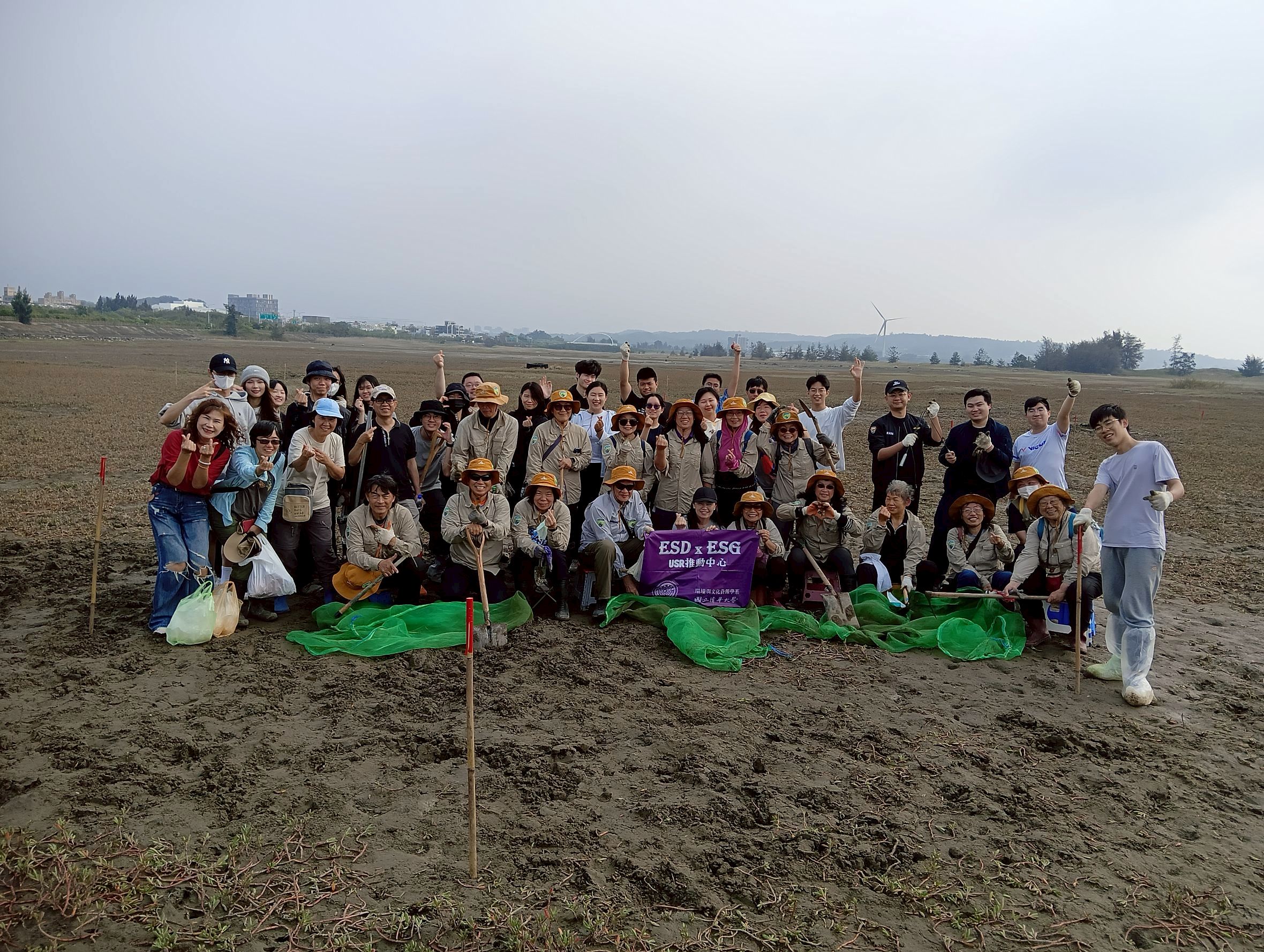
In November 2025, the Hsinchu City Government collaborated with a Taiwan Semiconductor Manufacturing Company (TSMC) employee group and an NTHU USR team in an experimental oyster-shell reef construction activity at Xiangshan Wetland.
Associate Professor Chih-Liang Chao of NTHU's Department of Environmental and Cultural Resources led graduate students who served as activity instructors and supported participants during habitat construction.
The activity reused oyster shells and structures associated with local oyster farming to explore the creation of three-dimensional reef habitats.
3.3 Habitat-Based Conservation Measures
The experimental oyster-shell reef initiative was designed to:
- Stabilize sediments: Explore ways to reduce disturbance and erosion in selected intertidal areas.
- Protect seagrass beds: Provide a physical structure intended to limit trampling and digging impacts.
- Enhance habitat complexity: Create surfaces and spaces potentially usable by fish, shrimp, molluscs, and other aquatic organisms.
- Promote resource circularity: Reuse discarded oyster shells as materials for nature-based habitat construction.
This activity connects habitat management with the ecological requirements of seagrass and intertidal organisms.
The available evidence confirms NTHU's direct participation in the restoration trial. It does not yet establish long-term improvements in seagrass coverage, species abundance, or water quality.
Supporting evidence:
NTHU Department of Environmental and Cultural Resources — Associate Professor Chih-Liang Chao
4. Linking Local Species Diversity to Habitat Management
The Xiangshan Wetland initiatives illustrate how ecological requirements can inform conservation interventions.
Conservation focusIdentified habitat concernManagement responseTaiwan fiddler crabExpansion of vegetation into open intertidal mudflatsExperimental vegetation removal and follow-up population surveysSeagrass bedsSediment instability and human disturbanceExperimental oyster-shell reef constructionFish, shrimp, molluscs, and benthic organismsAvailability and complexity of suitable habitatsHabitat structure enhancement, with long-term outcomes requiring monitoring
The Taiwan fiddler crab case provides a documented sequence of experimental vegetation management in 2024 followed by ecological observations in 2025.
The oyster-shell reef activity represents a separate habitat restoration trial conducted in 2025 with direct NTHU participation.
Together, these cases illustrate biodiversity-informed habitat management and university participation in local conservation practice.
5. Cross-Sector Collaboration and University Social Responsibility
Protecting shared wetland ecosystems requires cooperation among government agencies, ecological specialists, universities, businesses, and local communities.
In the Xiangshan Wetland initiatives:
- The Hsinchu City Government leads wetland conservation and relevant habitat management activities.
- Commissioned ecological and restoration teams contribute scientific surveys, ecological assessment, and restoration methods.
- NTHU participates through faculty members, graduate students, and USR activities, supporting habitat restoration, environmental education, and collaboration.
- Business and community participants contribute to collective environmental action and on-site conservation activities.
During the 2025 oyster-shell reef event, NTHU graduate students supported ecological interpretation and practical field activities.
The partnership connected species and habitat conservation with public participation and environmental learning, demonstrating how university expertise can contribute to wider regional biodiversity protection efforts.
6. Documented Outcomes in 2025
The available evidence establishes three relevant areas of activity and monitoring.
1. Follow-up monitoring of Taiwan fiddler crab habitats
Ecological surveys conducted in 2025 identified increased Taiwan fiddler crab density in areas where experimental vegetation removal had previously taken place. NTHU had participated in the university collaboration supporting the 2024 intervention.
2. Experimental oyster-shell reef habitat construction
In November 2025, an NTHU USR team led by Associate Professor Chih-Liang Chao participated in a government-led oyster-shell reef activity intended to protect seagrass habitat and support intertidal biodiversity.
3. Location-specific ecological monitoring information
The Hsinchu City Government has published 2025 reports addressing wetland ecology, water quality, horseshoe crabs, seagrass beds, and protected-area maintenance.
These provide supporting information on local biodiversity and conservation priorities. Unless further collaboration records are available, they are not presented as research conducted independently by NTHU.
7. Relevance to THE Impact Rankings 14.5.5
Indicator 14.5.5 concerns the implementation of a watershed management strategy based on the location-specific diversity of aquatic species.
NTHU's participation in the Xiangshan Wetland initiatives demonstrates several aspects of biodiversity-informed conservation:
- Experimental vegetation management responding to the habitat requirements of the endemic Taiwan fiddler crab.
- Follow-up ecological surveys evaluating changes in crab density within intervention areas.
- Experimental oyster-shell reef construction addressing seagrass and intertidal habitat protection.
- Cooperation with public authorities, researchers, businesses, and community participants to support practical habitat management.
These documented activities go beyond general environmental awareness and show NTHU's participation in species- and habitat-specific conservation interventions.
Nevertheless, the overall wetland management programme is administered by the Hsinchu City Government. The available evidence does not establish that NTHU independently designed or implemented a comprehensive watershed-wide management strategy.
This webpage therefore documents NTHU's participation in biodiversity-informed aquatic habitat management and restoration within a broader government-led conservation framework.
8. Future Development
The Xiangshan Wetland initiatives demonstrate the importance of understanding local species requirements and linking ecological evidence with practical habitat management.
NTHU's participation in Taiwan fiddler crab habitat restoration and oyster-shell reef construction illustrates the contribution universities can make through research expertise, USR activities, and cooperation with local partners.
Future collaboration may strengthen long-term monitoring of species distribution, vegetation change, seagrass conditions, and habitat restoration outcomes.
By connecting scientific knowledge, local governance, community participation, and university social responsibility, NTHU supports biodiversity conservation and sustainable management of coastal aquatic ecosystems.
Supporting Evidence
- Hsinchu City Government — Taiwan Fiddler Crab Habitat Restoration and NTHU Participation. Published in 2026, documenting 2024 participation and 2025 survey outcomes.
- National Council for Sustainable Development — Oyster-Shell Reef Construction at Xiangshan Wetland. November 13, 2025.
- Hsinchu City Government Xiangshan Wetland Ecology Website — Ecological Monitoring and Conservation Reports.
- NTHU Department of Environmental and Cultural Resources — Associate Professor Chih-Liang Chao.
Evidence qualification: This webpage focuses on documented 2025 conservation activities and outcomes, with the 2024 vegetation removal trial included as historical background. Conservation actions newly undertaken in 2026 are not counted as 2025 achievements.